


No ads. No Popups. No Paywalls.
Just a pure creative space for inspiration, experimentation, and exploring the human experience.
What this is | Start Here | The Why | About the Founder
What this is
House of Normal is a creative lab, journal, and archive — experiments, reflections, and collected projects by founder Damien K. Quick.
Start Here
- The Lab → Capturing Dragons - A fiery photographic experiment.
- The Journal → launching Q1 2026
- Miscellaneous Debris → Single Pencil - Giant Box
- Browse everything → The Archive
The Why
From late 2024 through 2025, once again, I was transitioning from full-time work to running my own creative business. I tested countless systems and website iterations, marketing campaigns and spending most of my time on the business side trying to make money—and less time doing the things that inspired the change in the first place.
I was pushing art sales and pay-walling content. Spending way too much time on social media, playing the trivial “constant posting” game to help funnel traffic toward sales pages but all the while something about it didn’t feel right.
In November 2025, I finished 12 months on the Australian Government’s Self-Employment Assistance Program. By their definition, it was not a success—I didn’t reach a sustainable income within 12 months. But the process gave me something more valuable: experience, insight, and a clearer understanding of how I function as a creative and as a person. I spent that year exploring mission and values, and constantly reshaping my web presence as I was reshaping myself.
Over the 2025–2026 end-of-year break, I recalibrated. Why, after more than a year chasing this idea do I still feel unfulfilled? I removed social media from my phone and read several books, trying to figure out what was going on.
The main problem here I had “niched down” into a very limited set of creative skills—art and animation. But my interests are broad, very broad and always expanding. Focusing on such a narrow slice of my interests felt extremely limiting whenever I wasn’t actively producing along those lines.
Niching down started to feel like binding myself in chains.
In the past, I’ve moved through many lines of work—sign fabrication, animation, photography, production management, AV and maintenance tech and more—and in my own time I’ve explored all kinds of creative processes. I can’t be an artist without referencing photography. I can’t talk about animation without mentioning the short films that led me into feature films, television series, and animation production management. It’s all connected.
So the key for me is to de-niche: open my world back up, allow all kinds of creative experimentation, and create a space where I can share openly and honestly—about both new discoveries and past experiences.
And so we have this website.
Free for all. No ads. No pop-ups. No paywalls.
Enjoy.
About the Founder
Damien K. Quick. The “K” means my parents either had a cruel streak or a sense of humour. And given the surprising number of Damien Quicks in the world, I’m officially announcing the return of the long-unmentioned middle name: Kingsley.
I could call myself an “artist” or a “creative” or whatever label fits this week, but honestly? Let's just say I'm a 'compulsive creative tinker-thinker' and leave it at that.
As a kid I lived all over Australia — the Northern Territory, central New South Wales, and across north and south-east Queensland. We also travelled a lot: northern Western Australia, the Kimberley, Kakadu, Uluru, and the salt lakes of South Australia. I even spent time in remote communities.
School-wise, I was usually behind — constant moving meant constant curriculum changes, and undiagnosed dyslexia didn’t exactly help. But from an early age I was developing a neurodiverse kind of superpower.
By five years old I was already pulling things apart to see how they worked… and mostly putting them back together again, usually with a few leftover mystery bonus screws. My Mum would sometimes throw my “broken” toys in the bin, but to me they weren’t broken — finding out how things worked was a pathway to imagination and future possibilities.
Despite my difficulties at school, I was always learning. I was obsessed with my Dad’s National Geographic collection and the Marshall Cavendish Insight magazines from the 1980s. Science and technology, space exploration, robotics — I was fascinated.
But because I was also considered “good at art”, my focus was guided more in that direction.
After yet another move in 1986, at a new school, I was introduced to the Commodore 64. A whole world I hadn’t seen first-hand. I became obsessed — games, BASIC programming (which I sucked at), and a whole expanse of sci-fi game cover art to add to the inspiration pile.
Fast forward to my final year of high school in 1993: I left school a year before graduating, with straight A’s and B’s in Art, and honours certificates from TAFE in engineering drafting and visual art & design.
And welcome to unemployment.
Back then I couldn’t get into university to study animation, architecture, or fine art because — despite my strong performance in electives, and what I was told was “an impressive portfolio” — my unsatisfactory results in core subjects like English and maths left a lot to be desired.
So that was that. After an uninspiring attempt at night-school English to boost my entry score, I resigned myself to casual work at a supermarket, stacking shelves in fruit and veg.
I saved up enough to buy a Commodore Amiga 1200 with an 800MB hard drive, 16MB of RAM, and a multisync monitor — around AU$4,000 in 1995, (thats AU$8,836.92 in 2026 by the way) and considered insanely over-the-top in power and performance at the time — and started teaching myself 3D rendering and animation, digital art, and… game game game.
From there I bounced through random jobs: metal manufacturing, factory work, whatever paid. Until a friend’s dad offered me a short temp contract. He’d left a plastics fabrication teaching job (he literally wrote the textbook on it) to start his own business.
That “three-week project” turned into seven years full-time, and then another seven on-and-off part-time.
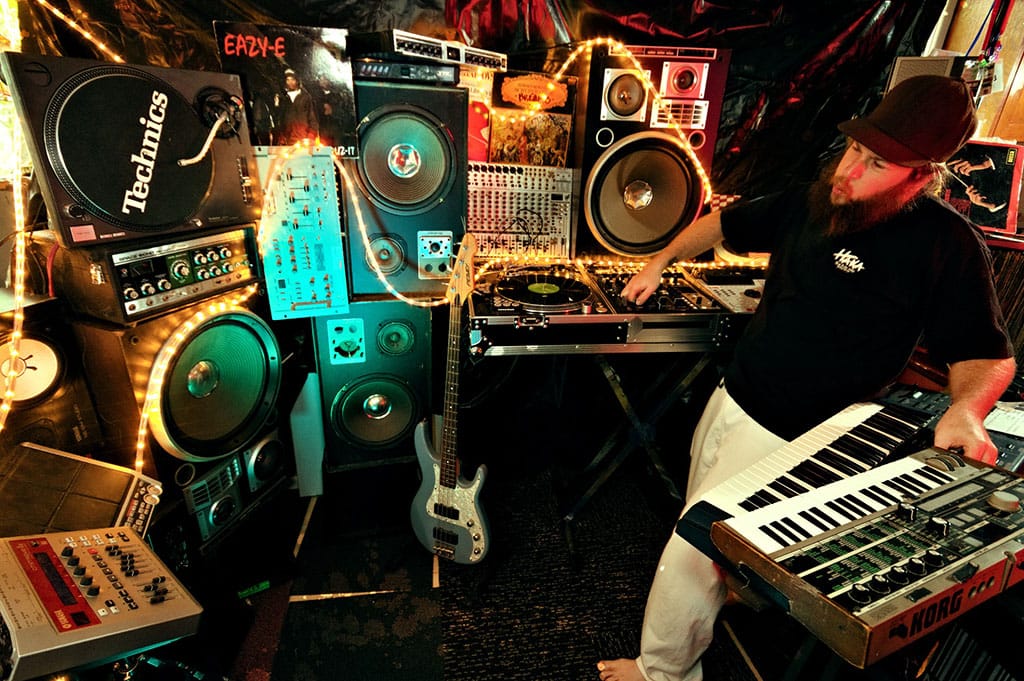
The steady income, access to tools, and eventually new tech — bench-sized laser cutter, CNC routers, the lot — lit the fuse again. We built custom tools for specific jobs, and in my spare time I was inventing things, building custom stereo equipment, trying new art techniques, playing music… I even played live breaks & beats and drum ’n’ bass in the local night club scene.
I tinkered with electronics, short films, animation, and photography experiments. And with the support of the boss, I took professional animation classes, built a folio, and after a few attempts scored work at an animation and post-production facility at Movie World Studios on the Gold Coast… as an assistant receptionist and production assistant. Not glamorous, but it was a foot in the door.
From there I learned film and animation production processes, edited confidential proposal documents, then expanded into video editing for facility promo reels. Before long I became the go-to guy for everything they didn’t have a dedicated person for: airport pickups, designing and producing printed marketing material, helping IT, and eventually working directly with the company owner and creative director across a wide range of projects.
He became a mentor — the kind who’d grin when I said “that can’t be done”… and then calmly show me how it’s done.
However, after a few years the film and TV industry collapsed in Australia. I moved through a few production management roles and eventually started my own business, Monkwhy Audio Visual, working as a freelance AV tech: photography and camera operation, lighting, vision, installing and operating LED screens, and running video switchers and everything in-between.
Fast forward: after a string of roles across a few industries — mining maintenance, pilot plant work — and an unfinished attempt at an engineering degree, I eventually came full circle and asked myself at 49:
What do I actually want to be doing with my life?
And so here we are. Compulsive. Obsessive. Creative. Tinkering and Thinkering.
Following curiosity wherever it leads — exploring, making, and always learning.
And sharing it all with you — in detail.